The Biggest Risk Is Often Doing Nothing
Published October 2026
Most of us are quite good at spotting the risks involved in changing something.
Start a business?
It might fail.
Change career?
You might regret it.
Invest money?
You might lose it.
Move somewhere new?
You might hate it.
Try something you're not naturally comfortable doing?
You might make a fool of yourself.
Those risks are easy to see because taking action creates a clear point at which something could go wrong.
There's another risk we don't examine nearly as carefully.
What happens if we do nothing?
Doing Nothing Feels Safe
That's the problem.
Doing nothing rarely feels like a decision.
If you turn down an opportunity, there may be no immediate consequence.
Tomorrow looks remarkably similar to today.
You haven't lost any money.
You haven't embarrassed yourself.
Nothing has gone wrong.
Which can make doing nothing feel like the safe option.
But you've still made a decision.
You've decided that whatever happens if you continue on your current path is preferable to accepting the uncertainty of another one.
Sometimes that's absolutely the right decision.
But it deserves examining just as carefully as the alternative.
We Compare Risk With an Imaginary Version of Safety
I spent 29 years at BT.
It was a genuinely secure career and I'm enormously grateful for what it gave me.
But the world I entered at 16 isn't the world we live in today.
Companies disappear.
Industries change.
Technology replaces jobs.
Household costs increase.
Relationships change.
Health changes.
The economy changes.
None of that means we should live in a permanent state of anxiety.
It simply means that staying where you are doesn't freeze the world around you.
Doing nothing has consequences too.
They're just harder to see in advance.
There's a Cost to the Opportunities We Don't Take
We naturally notice losses.
If I invest £1,000 and lose £500, I know exactly what that decision cost me.
But suppose I decide not to do something that might have created £50,000 over the following ten years.
I'll never receive a statement showing:
Opportunity not taken: £50,000.
There won't be an invoice.
Nothing leaves my bank account.
The loss is invisible.
And, of course, we have to be careful here.
We can never know that an opportunity we rejected would definitely have succeeded.
Perhaps turning it down saved us from a disaster.
That's precisely the point.
Both choices contain uncertainty.
We shouldn't pretend action is risky while inaction somehow comes with a guarantee.
I Nearly Didn't Join Utility Warehouse
The timing wasn't right when the business was first shown to me.
So I didn't join.
It was nearly eighteen months before I eventually did.
There's nothing particularly dramatic about that.
I wasn't sitting at home agonising over a life-changing decision.
I had other things going on.
Utility Warehouse was simply something I didn't pursue at the time.
But with hindsight, there's an interesting question.
What if eighteen months had become forever?
I can't tell you exactly what my life would look like today.
Nobody can.
But I can point to things that exist because I eventually made a different decision.
Customers.
Partners.
Income.
Friendships.
Experiences.
Choices.
And ultimately some of the financial resilience that helped Emma and me make decisions we couldn't have imagined at the beginning.
None of that proves joining was guaranteed to work.
It proves something different.
A possibility only gets the chance to become something if you act on it.
The Risk of Waiting Is Particularly Sneaky
Waiting feels responsible.
I'll do it when I'm more confident.
When work is quieter.
When the children are older.
When I've got more money.
When life settles down.
When the economy improves.
When I know more.
Sometimes waiting is sensible.
But sometimes we're not waiting for a better time.
We're waiting for uncertainty to disappear.
And it won't.
The danger is that postponement doesn't usually announce itself as a permanent decision.
You say “not yet” often enough and one day discover that it quietly became “never.”
You Can Reduce Risk Without Eliminating Possibility
This is where I think discussions about opportunity sometimes become unnecessarily binary.
You don't always have to throw away the life you already have.
When I started Utility Warehouse, I didn't need to abandon everything else and declare that this was now my future.
It was another string to my bow.
That mattered.
I could test it.
Learn.
Build gradually.
Get things wrong.
Give myself time.
There are plenty of decisions in life where the sensible answer isn't all in or do nothing.
It's:
Start small enough that failure is survivable, but seriously enough that success is possible.
That seems a much more useful way of thinking about risk.
Regret Has Two Directions
We often ask ourselves:
“Will I regret doing this?”
Fair question.
But there's another one:
“Might I regret never finding out?”
I've made decisions that didn't work.
I've tried things that went nowhere.
I've spent money I probably wouldn't spend again.
I've undoubtedly wasted time.
That's life.
But failed attempts at least give you information.
You discover something.
You adjust.
You move on.
The opportunities you never explore are different.
They leave you with a question.
Doing Nothing Is Still a Choice
I'm certainly not suggesting that every opportunity deserves a yes.
Some deserve a very firm no.
Others deserve research, caution or simply better timing.
But I no longer think the sensible question is:
“Is taking this riskier than doing nothing?”
I'd ask:
“What are the risks of both choices?”
What might I lose if I act?
What might I lose if I don't?
What happens if this goes badly?
And what might become possible if it goes well?
Because safety isn't always found by avoiding change.
Sometimes the apparently safe decision simply hides its consequences better.
Doing nothing is still a choice.
Make sure you understand what you're choosing.
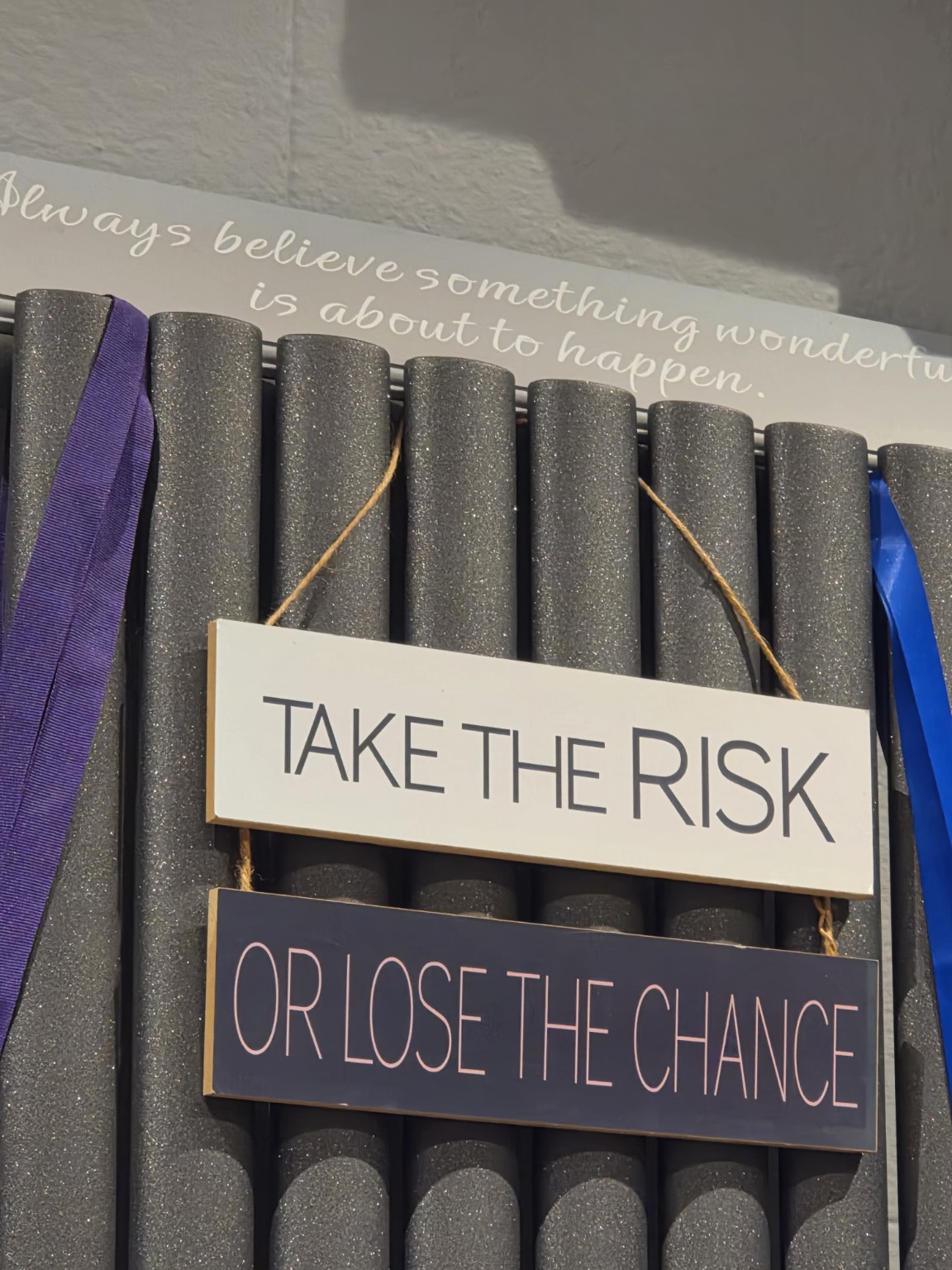
There's a small sign hanging on the wall in my office.
I've looked at it countless times, but it probably sums up this entire article in seven words better than I can:
TAKE THE RISK OR LOSE THE CHANCE.